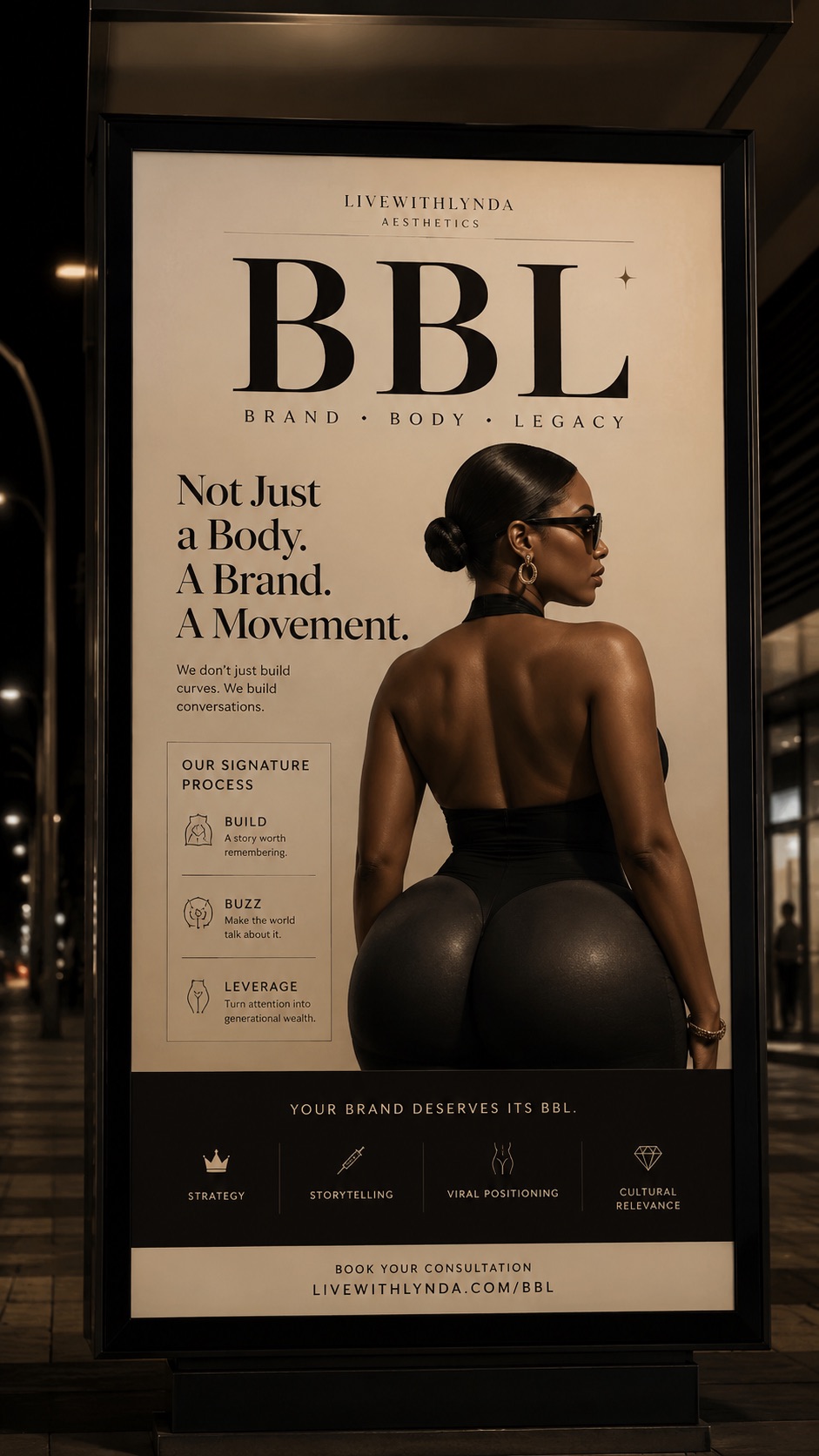
You’ve heard of the BBL. The body transformation that’s taken over timelines, sparked debates, and made its way into mainstream conversation whether people wanted it there or not.
Everyone has an opinion. Everyone is talking. That’s exactly what your brand needs to do.
Not the surgery. The strategy.
A Brand doesn’t survive today simply because it exists. It survives because people notice it, talk about it, remember it, defend it, repost it, associate emotions with it, and eventually choose it over countless alternatives.
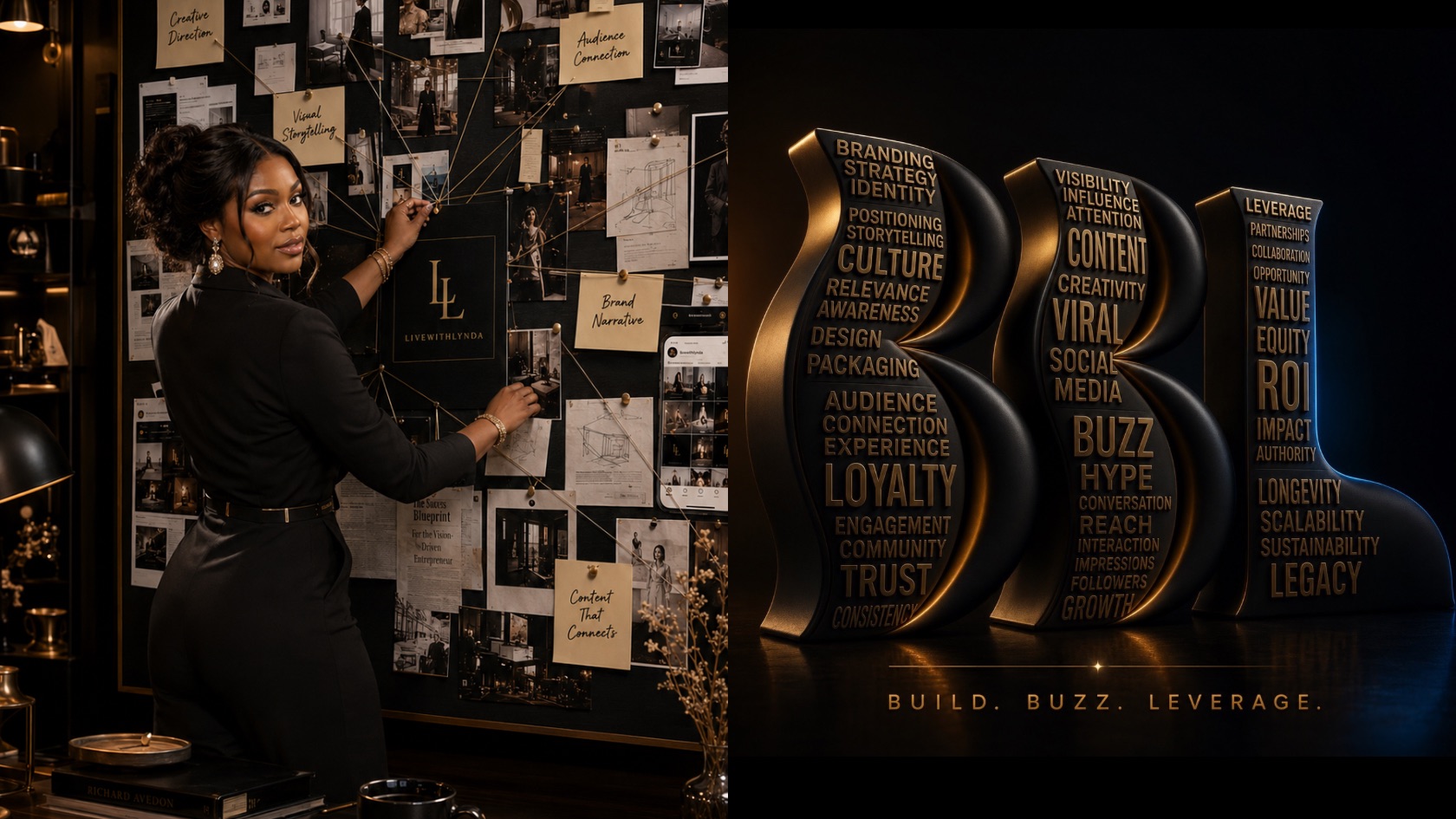
That’s why every modern brand needs a BBL: Build. Buzz. Leverage.
The BBL your brand actually needs is a deliberate transformation, from invisible to unmissable, from forgettable to referenced, from a business to a cultural moment.
That is the real BBL.
And contrary to what many people think, you do not always need a massive budget to pull this off.
You need strategy.
You need timing.
You need cultural awareness.
And most importantly, you need to understand human behavior.
Let’s break it down.
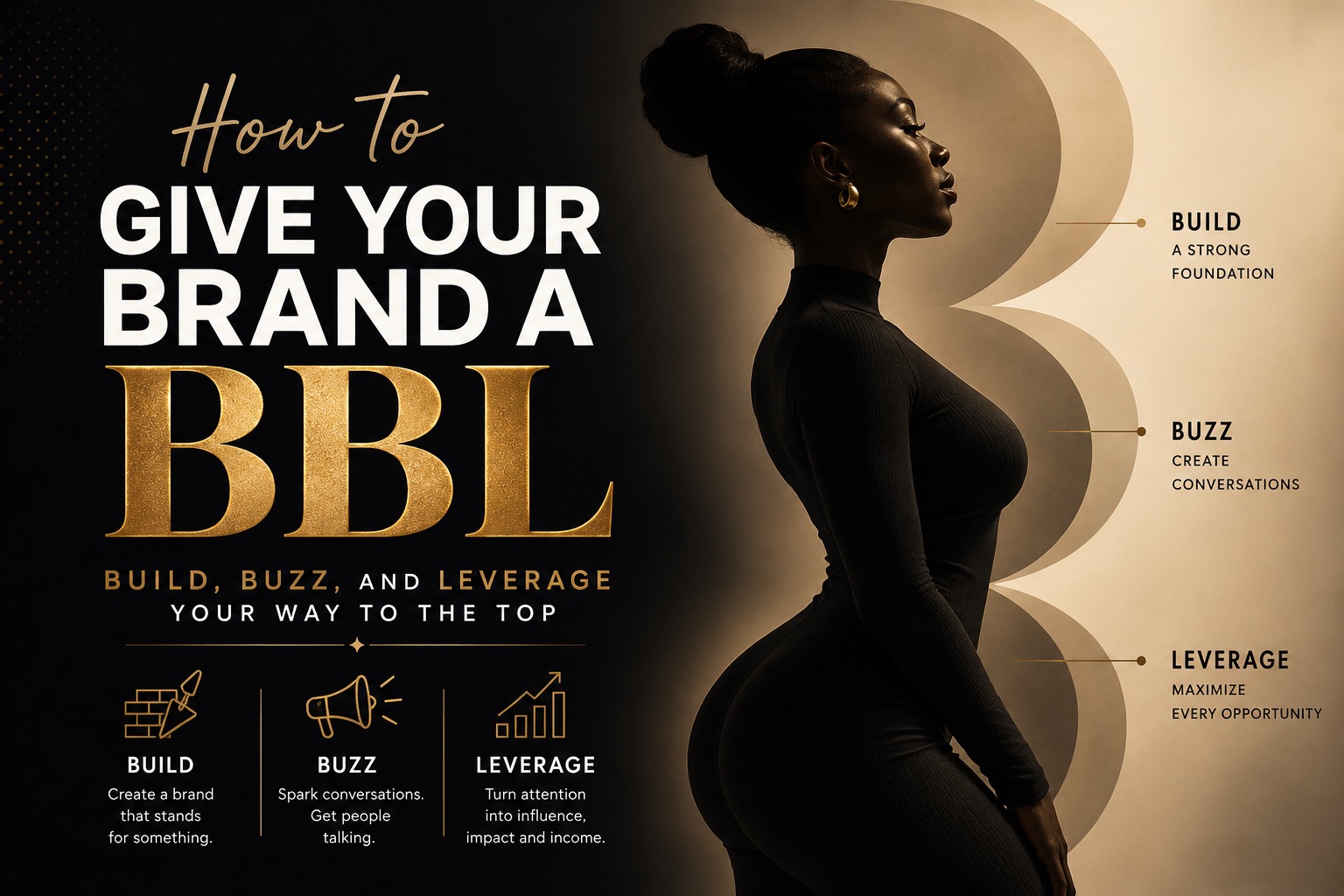 B = BUILD: Construct Something Worth Talking About
Nobody Talks About What Doesn’t Exist. But before you can generate buzz, you need to build something to buzz about. The first mistake many brands make is focusing too much on marketing before they build anything meaningful enough to market.
Build something with real substance or a distinct point of view.
A product is not a brand.
A logo is not a brand.
A photoshoot is not a brand.
A social media page is not a brand.
A real brand is a feeling people consistently associate with you. To get that feeling, you need to build a world around your brand… a universe that people want to enter.
Start with a perspective, not a product pitch.
The brands that earn organic attention aren’t the ones screaming “buy this.” They’re the ones saying something.
The strongest brands are built around one or more of these things:
- Identity
- Emotion
- Utility
- Community
- Aspiration
- Culture
- Consistency
People don’t wear Nike because it’s just sportswear. People wear Nike because Nike, it feels like ambition.
People don’t buy Apple because it’s just technology. People buy Apple because it feels premium, intuitive, and socially validating.
Closer home in Nigeria, look at what Indomie did, quietly and consistently, for decades. They studied the Nigerian market and focused on a specific target audience – women in their productive age, career women, wives, and mothers. That woman who wants to cook tasty food in the shortest time and move on.
They drew most of their content and advertising from this audience. And today, “Indomie” has become the generic term for instant noodles in Nigeria, regardless of brand.
That’s not just market share, that’s cultural ownership. And it started with a very clear point of view about who they were building for.
Your perspective, even a slightly unconventional or countercultural one, is your foundation.
Go specific.
Go deep.
Go human.
Go Build.
And building does not always require money.
Sometimes it requires clarity.
The Small-Budget Advantage
Ironically, smaller brands often have one major advantage over large corporations:
They can move faster and feel more human.
Big brands usually go through approvals, committees, legal reviews, and corporate fear before posting a tweet. A small creator, startup, or business owner can react instantly to culture.
That agility is power.
If you have little or no budget, focus on:
- Strong storytelling
- Clear positioning
- Relatable personality
- Cultural relevance
- Consistent visuals
- Emotional resonance
Practical moves with no budget:
Own a niche conversation: Pick one topic adjacent to your brand and become the most interesting voice in that space. A candle brand that talks about the psychology of scent and memory. A clothing brand that dissects Ankara’s place in global fashion history. Go deep, not broad.
Develop a signature format: A weekly question you post. A recurring series. A consistent visual style. Repetition builds recognition, and recognition builds trust.
Build in public: Share the process – the mistakes, the pivots, the behind-the-scenes decisions. Nigerian audiences are increasingly drawn to founders who are visible and honest. Transparency is a free differentiator.
People support brands they emotionally understand. That is why some low-budget brands outperform richer competitors online.They feel alive.
The goal of the Build phase is simple: create something so specific, so intentional, so you, that when people encounter it, they feel like they’ve found something, not been sold something.
B = BUZZ: Engineer the Moment, Then Let People Carry It
 Attention Is the New Currency. But Buzz isn’t luck. It’s architecture.
You can build the greatest brand in the world, but if nobody is talking about it, growth becomes painfully slow. Modern marketing is no longer only about advertising. It’s about conversation.
The brands that seem to “accidentally” go viral are almost always doing something very deliberate, they’re creating conditions for conversation. They understand that people share things for emotional and social reasons: because something made them laugh, made them think, made them feel seen, or made them look good for sharing it. Your job is to give them something worth passing on.
The smartest brands today don’t just create content. They create moments. And moments spread because humans naturally love:
- Controversy
- Humor
- Aspiration
- Relatability
- Surprise
- Identity signaling
- Emotional storytelling
This is why memes travel faster than corporate flyers. Why people repost funny takes faster than product features. Why emotionally charged stories outperform polished advertisements.
Buzz is not noise. Buzz is emotional movement.
The Anatomy of Organic Buzz
Buzz lives at the intersection of relevance and surprise. Relevance means it connects to something people already care about – a cultural moment, a shared frustration, a universal Nigerian experience. Surprise means it comes at the topic from an angle people didn’t expect.
GTBank understood this perfectly. A bank hosting a fashion show sounds counterintuitive until you see the genius. GTBank transformed traditional banking communication into cultural moments through its annual Fashion Weekend. The event goes beyond a fashion show; it is an avenue to celebrate fashion, creativity, and business, bringing together local SME retailers in fashion and beauty and helping them gain visibility, exposure to a wide audience, and a vast media presence. GTBank didn’t just buy attention. They created an event that gave people a reason to talk about them that had nothing to do with interest rates or account fees.
They showed up in a space where their customers actually lived – fashion, culture, community – and became relevant there.
That’s buzz architecture.
Practical Buzz-Building Moves With Little to No Budget
Tap into existing cultural conversations without being corny. One of the cheapest ways to grow is to enter conversations people are already having – Football, Fashion, Music, Pop culture moments, etc. Culture already has attention. Smart brands tap into it creatively.
The key is timeliness, relevance and authenticity. Twitter and TikTok moves fast. If a meme format, a trending topic, or a cultural debate aligns naturally with your brand’s voice, get in there quickly and creatively. If it’s a stretch, leave it alone.
Forced relevance is worse than silence. People can smell opportunistic marketing instantly.
Create shareable content
Make People Feel Smart for Sharing Your Content. The internet is driven by social validation.
People repost content that:
- Makes them look informed
- Makes them look funny
- Makes them look emotionally intelligent
- Makes them look culturally aware
- Makes them look early to trends
That’s why educational carousels, witty observations, unpopular opinions and insightful cultural commentary perform so well. People are not just sharing your content. They are sharing what sharing your content says about THEM.
Collaborate laterally, not just upward
You don’t need a celebrity endorsement.Find brands, creators, or communities at a similar stage to yours and create something together.
A small food brand and a lifestyle creator doing a “Nigerian home cooking” series. A fashion brand and a playlist curator building a “New Lagos Energy” campaign.
Collaborative buzz spreads to two audiences at once.
Make your customers the story
Feature them. Quote them. Celebrate their transformations, their creativity, their loyalty. User-generated content is not just free marketing – it signals to your broader audience that real people have real relationships with your brand.
Nigerians trust people like them far more than they trust polished campaigns.
Engineer a reason to be quoted
The brands that get talked about offline – in group chats, at owambe, in comment sections – say things that stick. Develop a line, a slogan, a visual, a ritual that people naturally reference. Something that becomes shorthand. Indomie didn’t just sell noodles – they gave Nigeria a word.
What word does your brand own?
Use Scarcity and Exclusivity
People naturally desire what feels limited. That’s why private communities, invite-only launches, waitlists, exclusive drops, and insider language work so well. Humans want to belong.
Even with no budget, you can create perceived exclusivity through: insider terminology, community nicknames, limited drops, early access, hidden experiences and VIP-style treatment. This is one reason fan communities become so powerful. They feel part of something.
Buzz isn’t about reaching everyone. It’s about reaching the right people so intensely that they carry your brand into spaces you could never access alone.
L = LEVERAGE: Turn Attention Into Assets
This is where most brands waste their BBL moment. They get the buzz – the viral post, the press mention, the influx of followers – and then they go back to business as usual.
The moment fades. The momentum dies. They become irrelevant.
Because they never converted attention into assets. Buzz without leverage is wasted attention. The smartest brands understand that every moment of attention should lead somewhere.
Leverage is the strategy of turning every win into a launching pad for the next one.
The question is:
“What are you building FROM the buzz?”
Attention Should Become:
- Community
- Mailing lists
- Partnerships
- Trust
- Brand recall
- Customer loyalty
- Distribution
- Data
- Cultural positioning
- Revenue opportunities
A viral moment is not the goal. It is fuel.
How to Leverage Without a Budget
Capture and catalog every proof point. Screenshots of organic mentions. Testimonials. Comments that say something real. These are not just feel-good moments, they are credibility assets. Deploy them in your content, your pitches, your conversations with potential partners.
Nothing sells like evidence.
Repurpose relentlessly
One viral tweet becomes a graphic. That graphic becomes a print. That print becomes a product. That product becomes a campaign.
Great brands don’t let good ideas die in their original format, they migrate them across channels and extend their life. In a market like Nigeria where data costs money, give people a reason to save and revisit your content.
Use attention to open doors
A spike in visibility is a window. Pitch products, services, discounts, publications, etc., while your engagement is high. Reach out to potential collaborators while your name is circulating. Apply for opportunities while momentum is on your side.
People (clients, investors, partners) respond to brands that feel like they’re having a moment.
Build community, not just audience
An audience watches. A community participates. Convert your buzz into belonging – a WhatsApp community, a recurring Twitter Space, a monthly meetup, activations.
The brands with true longevity in Nigeria aren’t just followed; they’re joined.
Document the transformation
Remember, the BBL is a transformation story. Brands with staying power know how to narrate their own evolution – “where we started, where we are, where we’re going.”
Share that arc. It gives people a reason to stay invested in your story and feel like they were part of building something.
Leverage is not exploitation. It’s stewardship. It’s taking the attention people have gifted you and building something durable with it. These are not just feel-good moments, they are credibility assets. Deploy them in your content, your pitches, your conversations with potential partners.
Nothing sells like evidence.
So… Does Your Brand Need a BBL?
Absolutely. Not because your brand is bad, but because attention has changed.
The world is louder.
Competition is heavier.
Culture moves faster.
Algorithms reward relevance.
Audiences crave emotion.
To survive today, brands must do BBL.
A BBL changes how people perceive you. It signals that something has shifted… that you’re not the same as before, that there’s a new version worth paying attention to. Your brand’s BBL isn’t a gimmick. It’s a commitment to being intentional about how you show up in culture because Cultural Relevance Is the New Competitive Advantage.
So… Build something with a real perspective.
Create buzz by giving people something worth carrying into their conversations.
Leverage every moment of attention into something that lasts.
The brands people talk about aren’t always the ones with the biggest budgets. They are the ones with consistency, cultural intelligence, and the discipline to show up the same way, every single time, until they became part of who we are. You can do the same.
Now go get your BBL.